

If you have been prescribed pantoprazole, you may wonder whether it is already a generic medication or whether it has another name. This is a common question, especially when comparing prescription labels, pharmacy options, and familiar brand names. The generic name for pantoprazole is pantoprazole. It is also commonly listed as pantoprazole sodium, which refers to the salt form used in many medication products. Its best-known brand name in the United States is Protonix.
Pantoprazole belongs to a group of medicines called proton pump inhibitors (PPIs). Doctors prescribe it to reduce stomach acid and help manage certain digestive conditions. In this guide, you will learn about its generic and brand names, common uses, available forms, how it works, possible side effects, and important safety information.
What Is the Generic Name for Pantoprazole?
The generic name for pantoprazole is pantoprazole. It is the active medication responsible for reducing the amount of acid produced by the stomach.
You may also see it listed as pantoprazole sodium on prescription labels and medicine packaging. This is a common form of the drug used in pharmaceutical products.
Here are the basic details:
- Generic name: Pantoprazole
- Common pharmaceutical name: Pantoprazole sodium
- Brand name: Protonix
- Drug class: Proton pump inhibitor (PPI)
- Main purpose: Reducing stomach acid
- Common strengths: 20 mg and 40 mg tablets
- Administration: Oral tablets and certain injectable forms
Generic pantoprazole contains the same active ingredient as its corresponding brand-name version. Approved generic medications must meet applicable quality, strength, and performance standards.
If your prescription says pantoprazole sodium, it does not mean you have been given a completely different medication. It is the commonly used salt form of pantoprazole.
Is Pantoprazole a Generic or Brand-Name Drug?
Pantoprazole is a generic drug name, not simply a brand name.
Many people recognize the medication by its brand name, Protonix. However, pharmacies also dispense generic versions containing pantoprazole as the active ingredient.
The difference is mainly in the product name, manufacturer, packaging, and price.
For example:
- Protonix: A brand-name version of pantoprazole.
- Pantoprazole: The generic medication name.
- Pantoprazole sodium: A commonly listed pharmaceutical form.
Both brand-name Protonix and an appropriate generic equivalent are intended to deliver the same active medication.
A pharmacist can help confirm whether a generic product is an appropriate substitute for your prescription.
What Are the Brand Names of Pantoprazole?
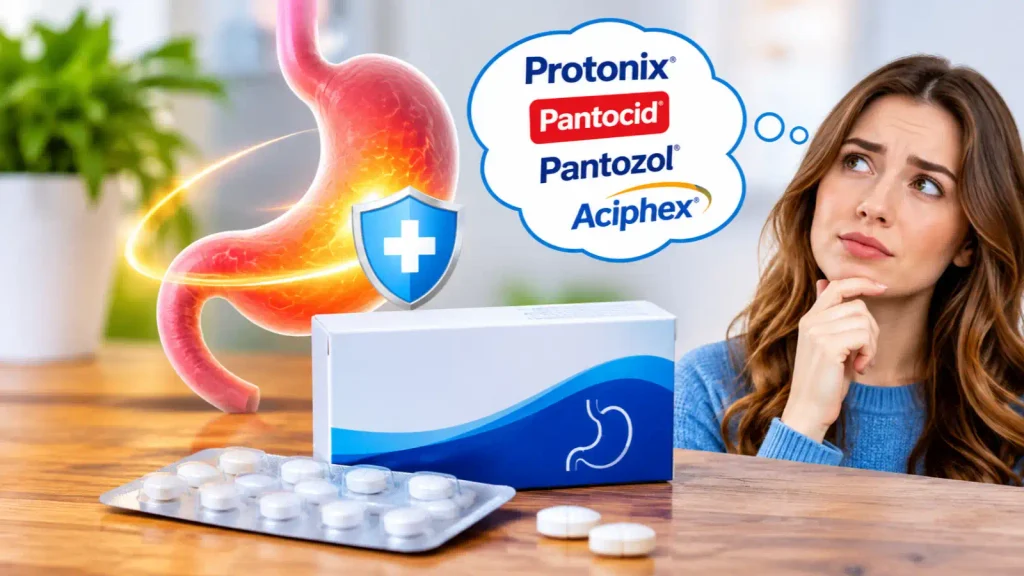
Pantoprazole is most commonly associated with the brand name Protonix in the United States.
You may encounter different product labels depending on the manufacturer, dosage form, and pharmacy.
1. Protonix
Protonix is the best-known brand name associated with pantoprazole in the United States.
It is used to reduce stomach acid and treat certain conditions related to excessive acid production.
2. Generic Pantoprazole
Generic pantoprazole is available from different pharmaceutical manufacturers.
It contains the same active ingredient as the corresponding brand-name product and may cost less.
3. Pantoprazole Sodium
Pantoprazole sodium is the name commonly printed on medication packaging.
It identifies the salt form used in many pantoprazole products rather than a separate acid-reducing drug.
Important: Brand names and product availability can vary between countries. Always check the active ingredient on the packaging instead of relying only on the product name.
What Is Pantoprazole Used For?
Pantoprazole reduces the production of stomach acid. Doctors prescribe it for several conditions involving excessive acid or acid-related irritation.
Some common uses include the following.
1. Gastroesophageal Reflux Disease (GERD)
GERD occurs when stomach contents flow backward into the esophagus.
This can cause heartburn, a sour taste, and irritation in the throat or chest.
Pantoprazole reduces stomach acid and helps relieve acid-related symptoms.
2. Erosive Esophagitis
Erosive esophagitis is inflammation and damage to the lining of the esophagus caused by stomach acid.
Pantoprazole can help the damaged tissue heal by reducing acid exposure.
3. Zollinger-Ellison Syndrome
Zollinger-Ellison syndrome is a rare condition in which tumors cause the stomach to produce too much acid.
Doctors may prescribe pantoprazole to control excessive acid production in people with this condition.
4. Stomach Acid-Related Conditions
Healthcare professionals may use pantoprazole as part of a treatment plan for certain acid-related digestive problems.
The exact reason for treatment depends on the patient’s symptoms, diagnosis, and medical history.
Pantoprazole is not an immediate-relief antacid. It works by reducing acid production over time.
How Does Pantoprazole Work?
Pantoprazole belongs to a medication group called proton pump inhibitors.
Your stomach contains specialized cells that produce acid to help digest food. These cells use structures called proton pumps to release acid.
Pantoprazole blocks these pumps and reduces the amount of acid released into the stomach.
This process can:
- Reduce stomach acid production.
- Relieve acid-related heartburn.
- Help heal irritation in the esophagus.
- Reduce acid-related discomfort.
- Support treatment of certain digestive conditions.
The medication does not completely stop your stomach from producing acid. Instead, it lowers acid production to a level that can help manage certain conditions.
Some people notice improvement within a few days, but the full benefit may take longer.
What Strengths Does Pantoprazole Come In?
Pantoprazole is available in different strengths and forms.
The appropriate option depends on the condition being treated and the healthcare professional’s instructions.
| Strength or form | Common use |
|---|---|
| 20 mg delayed-release tablet | Used for certain acid-related conditions |
| 40 mg delayed-release tablet | Commonly prescribed for GERD and erosive esophagitis |
| 40 mg oral suspension | Available for certain patients who need an alternative oral form |
| Injectable pantoprazole | Used in specific medical settings |
Not every form is available from every manufacturer or pharmacy.
Do not change your prescribed strength or switch between formulations without checking with your healthcare professional.
What Is the Difference Between Pantoprazole and Protonix?
Pantoprazole and Protonix are closely related because they refer to the same active medication.
However, they are not technically the same type of name.
| Feature | Pantoprazole | Protonix |
|---|---|---|
| Name type | Generic name | Brand name |
| Active ingredient | Pantoprazole | Pantoprazole |
| Drug class | PPI | PPI |
| Main purpose | Reduces stomach acid | Reduces stomach acid |
| Manufacturer | Multiple generic manufacturers | Brand product manufacturer |
The main difference is the product branding.
A generic pantoprazole product is designed to provide the same active ingredient as the corresponding brand-name medication.
However, inactive ingredients, packaging, and appearance may differ.
If you have concerns about switching products, ask your pharmacist to confirm the appropriate equivalent.
Common Side Effects of Pantoprazole
Like other medications, pantoprazole can cause side effects.
Many people tolerate it well, but some may experience mild discomfort.
Common side effects include:
- Headache
- Diarrhea
- Nausea
- Stomach pain
- Vomiting
- Gas
- Dizziness
- Joint pain
These effects may be mild, but you should contact a healthcare professional if they continue or become bothersome.
Serious Side Effects
Although less common, pantoprazole can sometimes cause more serious problems.
Seek medical advice if you experience:
- Severe or persistent diarrhea.
- Signs of an allergic reaction, such as facial swelling or difficulty breathing.
- Unusual muscle spasms or irregular heartbeat.
- Severe skin reactions.
- Signs of kidney problems, such as changes in urination.
- Persistent or unusual abdominal pain.
Difficulty breathing or swelling of the face or throat requires immediate emergency medical attention.
Long-term use of proton pump inhibitors may also be associated with certain risks, including low magnesium levels, vitamin B12 deficiency, and an increased risk of bone fractures in some circumstances.
These risks depend on factors such as treatment duration, dose, and individual health.
How Should You Take Pantoprazole?
Pantoprazole should be taken according to your prescription label and healthcare professional’s instructions.
The correct schedule depends on the condition being treated and the form of medication.
For delayed-release tablets, common instructions include:
- Swallow the tablet whole with water.
- Do not crush, chew, or split the delayed-release tablet.
- Follow the prescribed dosing schedule.
- Take it at the recommended time each day.
- Do not take extra doses to make up for a missed dose without appropriate instructions.
Pantoprazole tablets are commonly taken before a meal, often in the morning.
However, follow the specific directions provided with your prescription.
If you miss a dose, take it when you remember unless it is nearly time for your next scheduled dose. Do not double your dose.
Can You Buy Generic Pantoprazole Without a Prescription?
In the United States, prescription pantoprazole is generally available through a licensed pharmacy with a valid prescription.
A healthcare professional determines whether the medication is suitable for your condition.
Although generic medications may be less expensive than brand-name products, they are still regulated medicines.
Before starting pantoprazole, tell your healthcare professional about:
- Other medications you take.
- Existing medical conditions.
- Previous allergic reactions.
- Pregnancy or breastfeeding.
- Any ongoing digestive symptoms.
This information helps determine whether pantoprazole is a suitable treatment option.
Pantoprazole vs. Other Proton Pump Inhibitors
Pantoprazole is one of several medicines in the proton pump inhibitor family.
Other medications in this group also reduce stomach acid, but they have different active ingredients.
| Medication | Common brand name |
|---|---|
| Pantoprazole | Protonix |
| Omeprazole | Prilosec |
| Esomeprazole | Nexium |
| Lansoprazole | Prevacid |
| Rabeprazole | AcipHex |
| Dexlansoprazole | Dexilant |
These medications work in similar ways, but they are not identical.
They can differ in dosing, drug interactions, available formulations, and approved uses.
For example, omeprazole and pantoprazole both reduce stomach acid, but they contain different active ingredients.
Do not assume that one can replace another at the same dose without professional guidance.
Important Drug Interactions to Know About
Pantoprazole can interact with certain prescription medications and other substances.
Some interactions may affect how other medicines work or increase the risk of unwanted effects.
Examples include:
- Warfarin: Pantoprazole may affect monitoring of blood-thinning treatment in some patients.
- Methotrexate: Proton pump inhibitors may affect methotrexate levels, particularly with certain high-dose treatments.
- Certain HIV medicines: Some medications may have reduced effectiveness when taken with acid-reducing drugs.
- Certain antifungal medicines: Reduced stomach acidity can affect the absorption of some products.
This is not a complete list of possible interactions.
Give your pharmacist and doctor a complete list of your medications, including vitamins and supplements.
Do not stop a prescribed medication simply because you read about a possible interaction.
How to Choose Between Brand-Name and Generic Pantoprazole
If your doctor prescribes pantoprazole, you may have the option of receiving a generic version.
Both options can be suitable when the generic product is an approved equivalent.
Consider these points when discussing your options.
1. Check the Active Ingredient
Look for pantoprazole on the medication label.
The active ingredient is more important than the color, shape, or branding of the tablet.
2. Compare the Prescribed Strength
Make sure the product matches your prescribed strength and dosage form.
A 20 mg tablet is not automatically interchangeable with a 40 mg tablet.
3. Consider the Cost
Generic pantoprazole may cost less than brand-name Protonix.
Your final cost depends on your insurance plan, pharmacy, and available products.
4. Ask About Inactive Ingredients
Different manufacturers may use different inactive ingredients.
If you have allergies or sensitivities, ask your pharmacist to review the product ingredients.
5. Follow Medical Advice
Your healthcare professional can help determine whether the brand-name or generic product is appropriate.
The goal is to use the correct medication safely and consistently.
FAQs
What is the generic name for pantoprazole?
The generic name is pantoprazole. It is commonly available in a salt form called pantoprazole sodium. Protonix is a well-known brand name for this medication.
Is Protonix the same as pantoprazole?
Yes. Protonix is a brand-name product containing pantoprazole as its active ingredient. Generic pantoprazole is an alternative that contains the same active medication.
Is pantoprazole sodium the same as pantoprazole?
Pantoprazole sodium is a commonly used salt form of pantoprazole. It is not a completely different acid-reducing medication. It is the form found in many pharmaceutical products.
Is generic pantoprazole as effective as Protonix?
An FDA-approved generic equivalent must meet applicable standards for quality and performance. It is expected to provide the same clinical benefit as the corresponding brand-name product when used appropriately.
What is the most common strength of pantoprazole?
Pantoprazole is commonly prescribed in 20 mg and 40 mg delayed-release tablets. The appropriate strength depends on the condition and the healthcare professional’s treatment plan.
Is pantoprazole an antacid?
No. Pantoprazole is a proton pump inhibitor. Antacids neutralize stomach acid that is already present, while pantoprazole reduces the amount of acid your stomach produces.
Can I take pantoprazole every day?
Some patients take pantoprazole daily as part of a prescribed treatment plan. However, the appropriate duration depends on the medical condition. Long-term treatment should be reviewed periodically with a healthcare professional.
Can I switch from Protonix to generic pantoprazole?
In many cases, an approved generic equivalent can replace brand-name Protonix. However, confirm the strength and formulation with your pharmacist or prescriber before making a change.
Conclusion
The generic name for pantoprazole is pantoprazole, while Protonix is its familiar brand name in the United States. You may also see the medication listed as pantoprazole sodium on prescription labels and packaging.
This medicine belongs to the proton pump inhibitor family and works by reducing stomach acid. It is commonly prescribed for GERD, erosive esophagitis, and certain conditions involving excessive acid production.

Mr Zain created NameMeaningBase to help people explore the beauty and significance of names. From popular baby names to unique names and their origins, I strive to deliver useful insights that inspire curiosity and help readers find names with meaning.