

If you have seen hydrocodone listed on a prescription, medication bottle, or medical record, you may wonder whether it goes by another name. The answer depends on the context. Hydrocodone is the generic name of an opioid pain medication, but it is also sold under several brand names and combined with other medicines in certain prescription products.
Understanding these names can help you recognize a medication, read a prescription label, or have a more informed conversation with a pharmacist. It is also important to know that some names refer to hydrocodone alone, while others describe a combination of hydrocodone and another ingredient, such as acetaminophen.
This guide explains the most common alternative names, brand names, combination products, and related terms. It also covers important safety differences so you can identify the medication accurately rather than relying on a name alone.
What Is Another Name for Hydrocodone?
The simplest answer is that hydrocodone is the generic name, while Vicodin, Norco, and Lortab are well-known brand names associated with hydrocodone-containing prescription medications.
However, these names are not always interchangeable. Some products contain hydrocodone combined with acetaminophen, while others use different formulations. The exact ingredients depend on the specific medication.
Here are 12 important names and terms to recognize:
- Hydrocodone — The generic name of the opioid medication.
- Vicodin — A brand name historically associated with hydrocodone and acetaminophen.
- Norco — A brand name for a combination of hydrocodone and acetaminophen.
- Lortab — A brand name associated with hydrocodone and acetaminophen.
- Zohydro ER — A brand name for an extended-release hydrocodone formulation.
- Hysingla ER — An extended-release hydrocodone product.
- Anexsia — A brand name associated with hydrocodone and acetaminophen.
- Lorcet — A brand name associated with hydrocodone and acetaminophen.
- Xodol — A brand name associated with hydrocodone and acetaminophen.
- Hydrocodone bitartrate — A chemical form commonly identified in medication labeling.
- Hydrocodone/acetaminophen — The name of a combination medication containing both ingredients.
- Hydrocodone extended-release — A description of a formulation designed to release medication over an extended period.
Brand availability, labeling, and marketing status can change. Some names may refer to discontinued products or formulations that are not currently available in every location.
Common Brand Names for Hydrocodone
Brand names are often the first alternative names people encounter. A brand name identifies a marketed medication, but it does not necessarily tell you every ingredient or how the medicine releases into the body.
1. Vicodin
Vicodin is one of the best-known brand names associated with hydrocodone. Traditional Vicodin products combine hydrocodone with acetaminophen, a non-opioid pain reliever.
The acetaminophen component matters because taking additional acetaminophen can increase the risk of serious liver damage.
2. Norco
Norco is another familiar brand name for a hydrocodone and acetaminophen combination. The specific strength and formulation should always be checked on the prescription label.
3. Lortab
Lortab is a brand name associated with combination tablets containing hydrocodone and acetaminophen. As with other combination products, the total amount of both ingredients matters.
4. Zohydro ER
Zohydro ER was developed as an extended-release hydrocodone product. Extended-release formulations are designed differently from immediate-release products and have distinct prescribing and safety considerations.
5. Hysingla ER
Hysingla ER is a brand name for extended-release hydrocodone. It is intended for specific pain-management situations under medical supervision.
6. Anexsia
Anexsia is a brand name associated with hydrocodone and acetaminophen. The precise formulation and availability should be verified rather than assumed from the name.
7. Lorcet
Lorcet is another brand name historically used for hydrocodone and acetaminophen combination products.
8. Xodol
Xodol is a brand name associated with a hydrocodone and acetaminophen medication.
Important: Brand names may differ by country, manufacturer, and time period. A familiar name does not guarantee that a product is currently marketed or that its ingredients match those of a similarly named product.
Is Hydrocodone the Same as Vicodin, Norco, or Lortab?
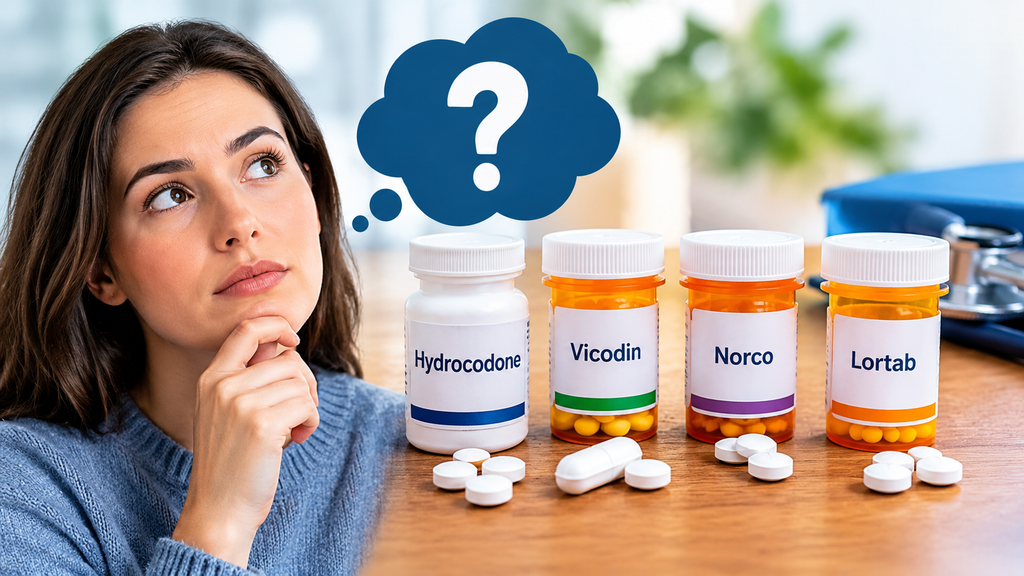
Not exactly. Hydrocodone is the active opioid ingredient, while Vicodin, Norco, and Lortab are brand names associated with products that combine hydrocodone with acetaminophen.
The distinction is important because a brand-name product may contain more than one active ingredient.
| Name | What it refers to |
|---|---|
| Hydrocodone | The opioid medication itself |
| Vicodin | A brand associated with hydrocodone and acetaminophen |
| Norco | A brand associated with hydrocodone and acetaminophen |
| Lortab | A brand associated with hydrocodone and acetaminophen |
| Hysingla ER | An extended-release hydrocodone product |
| Hydrocodone/acetaminophen | A generic combination-drug name |
For example, a prescription labeled hydrocodone/acetaminophen identifies two active ingredients. A prescription labeled hydrocodone alone may refer to a different formulation.
You should not assume that two products are equivalent simply because both contain hydrocodone. Their strengths, additional ingredients, and release mechanisms may differ.
Generic Names and Medical Terms for Hydrocodone
Medical records and pharmacy labels may use technical terms rather than familiar brand names. These terms can help you understand what a prescription contains.
Here are 12 useful terms and their meanings.
- Hydrocodone — The standard generic drug name.
- Hydrocodone bitartrate — A salt form commonly identified in the medication’s official ingredient name.
- Hydrocodone/acetaminophen — A combination of an opioid and a non-opioid pain reliever.
- Acetaminophen — The non-opioid ingredient included in many hydrocodone combination products.
- APAP — An abbreviation sometimes used for acetaminophen on medication labels or in clinical documentation.
- Opioid analgesic — A medical term for an opioid medicine used to relieve pain.
- Prescription opioid — A term describing an opioid supplied under a prescription.
- Immediate-release hydrocodone — A formulation designed to release the medicine without an extended-release mechanism.
- Extended-release hydrocodone — A formulation designed to release medication over a longer period.
- Combination analgesic — A pain-relieving product that contains more than one active ingredient.
- Active ingredient — The component responsible for the medication’s intended pharmacological effect.
- Generic medication — A medicine identified by its established drug name rather than a particular brand.
These terms do not all represent alternative names for hydrocodone. Some describe its formulation, its drug class, or another ingredient in the same product. Knowing the difference helps prevent confusion when reading medical information.
What Is Hydrocodone Called on a Prescription Label?
Hydrocodone can appear under different descriptions depending on the product, manufacturer, and prescription system.
Common label formats include:
- Hydrocodone bitartrate — A technical ingredient name.
- Hydrocodone/acetaminophen — A combination-product description.
- Hydrocodone bitartrate and acetaminophen — A fuller ingredient listing.
- Hydrocodone extended-release — A description emphasizing the release formulation.
- Hydrocodone oral tablet — A description of the dosage form and route.
- Generic hydrocodone — A general reference to the non-brand-name medicine.
A label may also show the amount of each active ingredient, the dosage form, the manufacturer’s name, and instructions from the prescriber.
Pay attention to the entire label rather than just the first word. For example, the presence of acetaminophen changes the product’s ingredient profile and introduces an additional consideration for safe use.
If a label is unclear, a pharmacist can confirm the medication’s identity, ingredients, and formulation.
What Drug Class Does Hydrocodone Belong To?
Hydrocodone belongs to a class of medicines called opioids. Opioids act on receptors in the nervous system to reduce the perception of pain.
It is generally prescribed for pain severe enough to require an opioid when other treatment options are inadequate or unsuitable. Its use requires careful medical oversight because it can cause serious side effects and dependence.
The following 12 terms are related to hydrocodone’s medical classification or effects:
- Opioid — The drug class to which hydrocodone belongs.
- Opioid analgesic — An opioid used to relieve pain.
- Pain medication — A broad term for medicine used to manage pain.
- Narcotic analgesic — A term historically used for certain opioid pain medicines.
- Central nervous system depressant — A description of drugs that can slow activity in the brain and nervous system.
- Mu-opioid receptor agonist — A pharmacological description of how hydrocodone produces many of its effects.
- Prescription medication — A medicine supplied under authorized prescribing rules.
- Controlled substance — A medicine subject to specific legal controls because of its potential risks.
- Analgesia — The reduction or relief of pain.
- Sedation — A state of reduced alertness that can occur with certain medications.
- Physical dependence — A condition in which the body adapts to a medicine and withdrawal symptoms may occur if it is stopped abruptly.
- Opioid use disorder — A medical condition involving a problematic pattern of opioid use that causes significant impairment or distress.
These are related medical terms, not synonyms for the drug itself. In particular, physical dependence and opioid use disorder are not the same condition.
Is Hydrocodone the Same as Oxycodone?
No. Hydrocodone and oxycodone are different opioid medications. Both can be prescribed for pain, but they have different chemical structures and may be available in different formulations.
They should not be treated as interchangeable medicines.
Here are some key differences:
- Generic names: Hydrocodone and oxycodone are separate drug names.
- Brand names: Hydrocodone is associated with brands such as Vicodin and Norco, while oxycodone is associated with brands such as Roxicodone and OxyContin.
- Combination products: Hydrocodone is found in combination products containing acetaminophen. Oxycodone is also available in combination products, including those containing acetaminophen.
- Extended-release products: Both medicines have formulations designed for extended release, but their products and instructions differ.
- Safety: Both can cause drowsiness, respiratory depression, dependence, and potentially fatal overdose.
A product containing oxycodone is not another name for hydrocodone, even if both medicines are prescribed for similar reasons.
Never switch between them or estimate an equivalent dose without guidance from a qualified healthcare professional.
Is Hydrocodone the Same as Codeine or Morphine?
No. Codeine, morphine, and hydrocodone are separate opioid medicines. They belong to the same broad drug class, but they are not identical.
Codeine is an opioid used in certain pain-relief and cough-treatment products, depending on the country and formulation. Its effects can vary between people because the body converts some codeine into morphine.
Morphine is another opioid used to manage pain. It is available in different formulations and has its own prescribing requirements.
Hydrocodone is also an opioid pain medication, with its own formulations, approved uses, and safety considerations.
Although these medicines share some effects, differences in potency, metabolism, dosing, and formulation mean they cannot be substituted for one another on a name alone.
If you see any of these drugs listed in a medical record, check the exact generic name before assuming it refers to hydrocodone.
What Are Common Slang Names for Hydrocodone?
People sometimes use informal terms when discussing prescription opioids. However, slang varies by location, age group, and social setting, and the same word can refer to different substances.
For accurate identification, the generic name and the ingredients printed on the medication label are more reliable than slang.
You may encounter these general terms in conversations about hydrocodone:
- Pain pills — A broad, informal phrase for tablets used to relieve pain.
- Painkillers — A general term for medicines that reduce pain.
- Opioids — The drug class that includes hydrocodone.
- Prescription pain medicine — A general description of medication prescribed for pain.
- Prescription pain pills — An informal description of oral pain medication.
- Narcotics — A term commonly used for certain opioids, particularly in legal or medical discussions.
- Opioid pain relievers — A more precise description of medicines in this category.
- Hydrocodone tablets — A straightforward description of the tablet formulation.
- Combination pain medicine — A description of products containing multiple active ingredients.
- Extended-release pain medicine — A broad description of medicines designed to release their active ingredients over an extended period.
These expressions are not exact drug names. For instance, pain pills could refer to many medicines, including non-opioid products. It is best to use the medication’s full name when discussing treatment, identifying a prescription, or asking a pharmacist a question.
Important Safety Information About Hydrocodone
Knowing the correct name is useful, but understanding the medication’s risks is just as important. Hydrocodone can provide pain relief when appropriately prescribed, yet it can also cause serious harm if misused.
Common side effects
Possible side effects include:
- Drowsiness
- Dizziness
- Nausea or vomiting
- Constipation
- Lightheadedness
Some side effects may become more serious at higher exposures or when hydrocodone is combined with other substances.
Dangerous drug combinations
Alcohol, benzodiazepines, sleeping pills, and other medicines that slow the central nervous system can increase the risk of severe sedation and breathing problems when taken with hydrocodone.
Do not combine these substances with hydrocodone unless your prescribing clinician has specifically assessed the combination and provided instructions.
Overdose warning signs
An opioid overdose can cause slow, shallow, or absent breathing, extreme sleepiness, inability to wake up, and unusually small pupils.
If an overdose is suspected, call emergency services immediately. Administer naloxone if available and follow the emergency dispatcher’s instructions. Do not leave the person alone.
Dependence and stopping treatment
Regular opioid use can lead to physical dependence. Stopping suddenly after prolonged use may cause withdrawal symptoms, so anyone who has been taking hydrocodone regularly should speak with their prescriber about an appropriate plan.
FAQs
What is the generic name for Vicodin?
Vicodin is a brand name associated with a combination of hydrocodone and acetaminophen. The generic name on a prescription may therefore appear as hydrocodone/acetaminophen. Check the exact label because formulations and product availability can vary.
Are Norco and hydrocodone the same thing?
Not exactly. Norco is a brand name associated with a hydrocodone and acetaminophen combination. Hydrocodone is the opioid ingredient, while acetaminophen is a separate pain-relieving ingredient.
Is Lortab another name for hydrocodone?
Lortab is a brand name associated with products containing hydrocodone and acetaminophen. It is not simply another generic name for hydrocodone, because the combination product includes an additional active ingredient.
What is hydrocodone called in medical records?
Medical records may list hydrocodone, hydrocodone bitartrate, or hydrocodone/acetaminophen. The exact wording depends on the medication and formulation. Reviewing the complete entry helps distinguish the opioid ingredient from a combination product.
Does every hydrocodone product contain acetaminophen?
No. Some hydrocodone products contain acetaminophen, while other formulations contain hydrocodone without that additional ingredient. Extended-release products may also differ from immediate-release products. Always check the active ingredients on the label.
How can I identify a hydrocodone pill?
Start by checking the original prescription packaging and medication label. If the packaging is missing or the pill is unidentified, ask a pharmacist to help verify it. Do not rely on color, shape, an imprint, or an informal name alone, and do not take a pill unless its identity has been reliably confirmed.
Conclusion
Hydrocodone is the generic name of an opioid medication, while Vicodin, Norco, and Lortab are familiar brand names associated with hydrocodone-containing combination products. Other terms, such as hydrocodone bitartrate and hydrocodone/acetaminophen, describe its ingredient or formulation.
The most reliable way to identify a medicine is to check its full name, active ingredients, and formulation.
If a prescription label is unclear, a pharmacist can help confirm exactly what it contains. Understanding these distinctions makes it easier to read medication information and avoid confusing similar but different drugs.

Mr Zain created NameMeaningBase to help people explore the beauty and significance of names. From popular baby names to unique names and their origins, I strive to deliver useful insights that inspire curiosity and help readers find names with meaning.